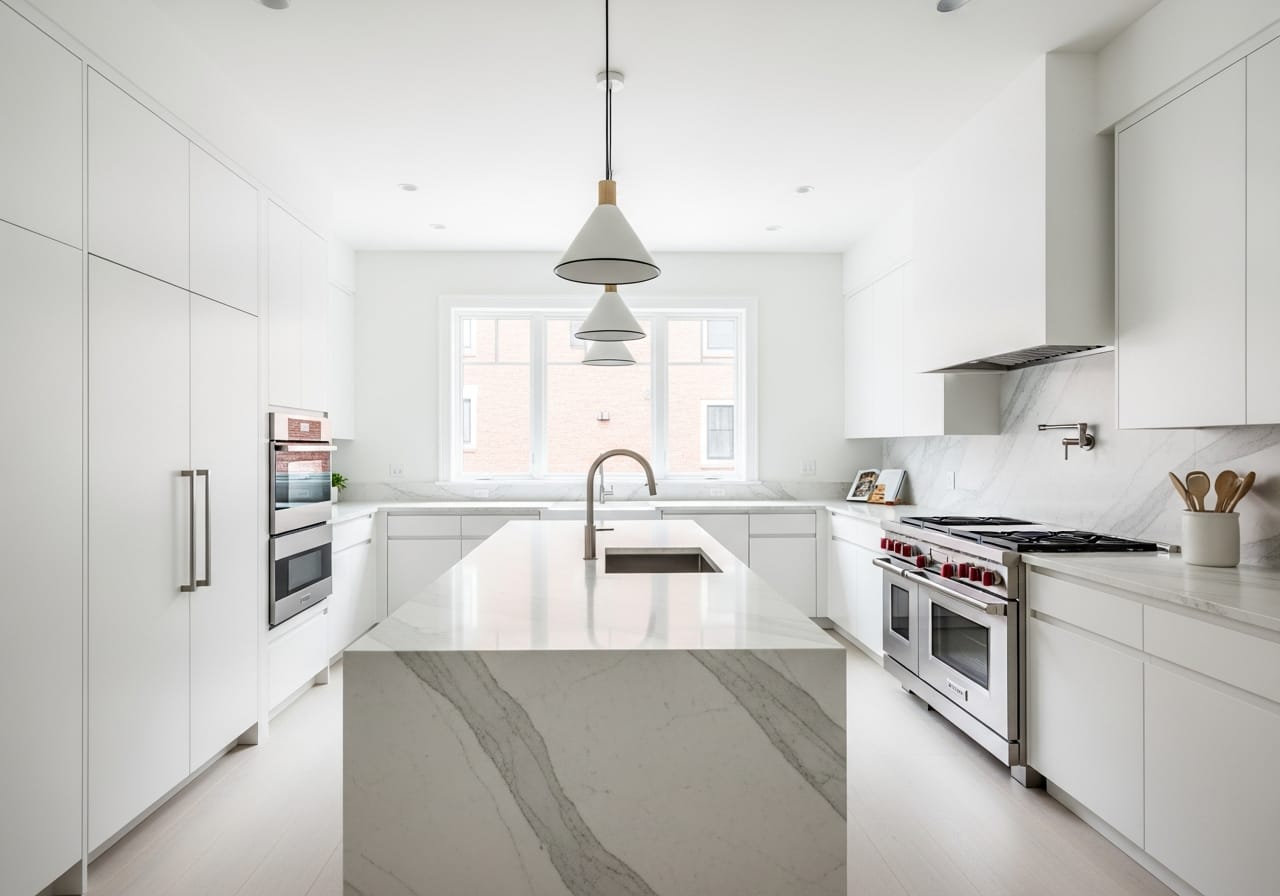
Part of our guide: Kitchen Renovation in Surrey: The Complete Planning Guide
Cabinets usually claim the largest single share of a kitchen renovation budget, and they are the one element you interact with dozens of times a day. Doors that sag, drawers that stick, and boxes that swell with humidity turn a beautiful kitchen into a frustrating one. This guide compares stock, semi-custom, and custom cabinetry, digs into the materials that actually matter, and helps you decide whether refacing or full replacement fits your kitchen and budget.
What is the difference between stock, semi-custom, and custom cabinets?
Stock cabinets are factory-made in fixed sizes, semi-custom lines let you modify dimensions and finishes within a manufacturer's system, and custom cabinets are built from scratch to your exact kitchen. The trade-off is flexibility versus price and lead time, with stock the quickest and custom the most tailored.
Stock cabinets come in standard widths, usually in three-inch increments, with a limited palette of door styles and colours. Filler strips bridge the gaps where your walls do not match the increments, which costs you some storage. They ship fast, which suits rental properties, flips, and tight timelines. Semi-custom is the middle ground most Surrey homeowners land on: you can adjust depths, choose from a much wider range of doors and finishes, and add organizers, while still benefiting from factory production. Custom cabinetry is built by a shop to the millimetre. In older homes around Greater Vancouver where floors slope and corners are out of square, custom boxes make wavy walls look intentional, and no space is lost to fillers. Lead times are longest for custom, often eight to twelve weeks from a local BC shop, so ordering early protects your schedule.
Which cabinet materials actually matter?
The box material and the door material matter more than the brand name on the catalogue. Plywood boxes outlast particleboard in kitchens, and door materials, melamine, thermofoil, painted MDF, or solid wood, each behave differently under heat, moisture, and daily knocks.
Here is the honest rundown. Melamine is a resin-coated particleboard, inexpensive and easy to wipe down, but chips at the edges and does not love standing moisture. Thermofoil is a vinyl skin heat-wrapped over MDF; it gives a smooth painted look at a lower price, but it can peel near ovens and dishwashers unless heat shields are installed. Painted MDF doors are the standard for shaker styles because MDF will not crack at the joints the way painted solid wood can as it expands and contracts through our humid winters and dry indoor heating season. Solid wood doors, maple, oak, walnut, bring grain and warmth and can be refinished, though they move with humidity, which is a real consideration in the Lower Mainland. For the boxes themselves, plywood holds screws better, resists sagging on wide spans, and shrugs off the minor water contact that eventually happens under every sink. If the budget forces a choice, put plywood in the sink base at minimum.
What door styles and hardware are worth choosing?
Shaker doors remain the safe, versatile choice for most kitchens, and soft-close hinges and drawer slides are the hardware upgrade that pays for itself in daily use. Beyond that, full-extension drawers and a few well-placed organizers do more for livability than any decorative extra.
Flat-panel slab doors give a clean modern look and are the easiest to wipe down, popular in newer Surrey and Vancouver builds. Raised-panel doors read traditional and suit character homes. Whatever the style, insist on soft-close hardware throughout; the mechanism prevents slamming, protects the doors, and is now standard on mid-range lines rather than a luxury. Drawers deserve special attention: deep pot drawers in the lower cabinets beat shelves behind doors for almost every household, because you see everything at a glance instead of crouching and reaching. A pull-out for recycling and garbage, a corner solution like a lazy susan, and one tray divider above the fridge cover most of the organization needs without inflating the order.
Should you reface your cabinets or replace them?
Reface when your cabinet boxes are sound and the layout works; replace when boxes are damaged, the layout fails you, or you want different storage. Refacing swaps doors, drawer fronts, and the visible skin of the boxes at a meaningful saving over full replacement.
Refacing makes sense more often than people expect. If your kitchen was built with solid boxes and you like where everything sits, new doors, new hardware, and a matching veneer on the exposed sides deliver most of the visual transformation for less money and far less disruption, often within a week. It is also the lower-waste option, which matters to many homeowners. Replacement is the right call when boxes are water-damaged or sagging, when you are changing the layout anyway, or when you want modern storage like deep drawers that old face-frame boxes cannot accommodate. One caution: refacing does not fix interiors, so if the shelves are peeling and the drawer slides are worn, price both options before assuming refacing wins.
How does cabinet choice drive the overall kitchen budget?
Cabinets set the ceiling and floor of a kitchen budget more than any other line item, which is why a full kitchen renovation in Surrey spans such a wide range, $25,000 to $80,000 and up. The same layout can land at very different totals depending on whether it is fitted with stock melamine boxes or custom plywood cabinetry with premium doors.
Because the cabinet order also dictates the schedule, lock the decision in early. Countertops cannot be templated until cabinets are installed, and backsplash follows counters, so a late cabinet change ripples through every following trade. A practical approach we use with clients: set the total project budget first, allocate cabinets as the anchor, then choose counters and backsplash from what remains, rather than picking finishes independently and hoping the sum works out. The full budgeting and sequencing picture is laid out in our complete kitchen renovation planning guide for Surrey, and our kitchen renovation service page explains how we manage the ordering and installation end to end.
Frequently asked questions
How long do kitchen cabinets take to arrive in BC?
Stock cabinets are often available within days to a couple of weeks. Semi-custom orders commonly take four to eight weeks, and custom cabinetry from a local shop typically runs eight to twelve weeks. Order before demolition begins so the site is never waiting.
Are IKEA-style flat-pack cabinets a good option?
Flat-pack systems can be a sensible budget choice when assembled and installed carefully, and upgraded hinges and slides narrow the hardware gap. Their fixed sizing still leaves filler gaps in irregular rooms, and assembly labour partly offsets the sticker savings.
Do I need new cabinets to get new countertops?
No. If your boxes are level and structurally sound, fabricators can template new quartz or granite over existing cabinets. It is a common way to stage a kitchen update across two budgets.
Deciding between refacing, semi-custom, and custom is much easier standing in your actual kitchen. Ali's Old To New General Contracting offers free consultations across Surrey and Greater Vancouver. Get in touch or call 778-861-6482 and we will help you match the cabinet approach to your space and budget.
More in This Guide
Services Related to This Guide
Planning a Renovation?
Get a free consultation and quote from a fully insured Surrey general contractor.
Get a Free Quote