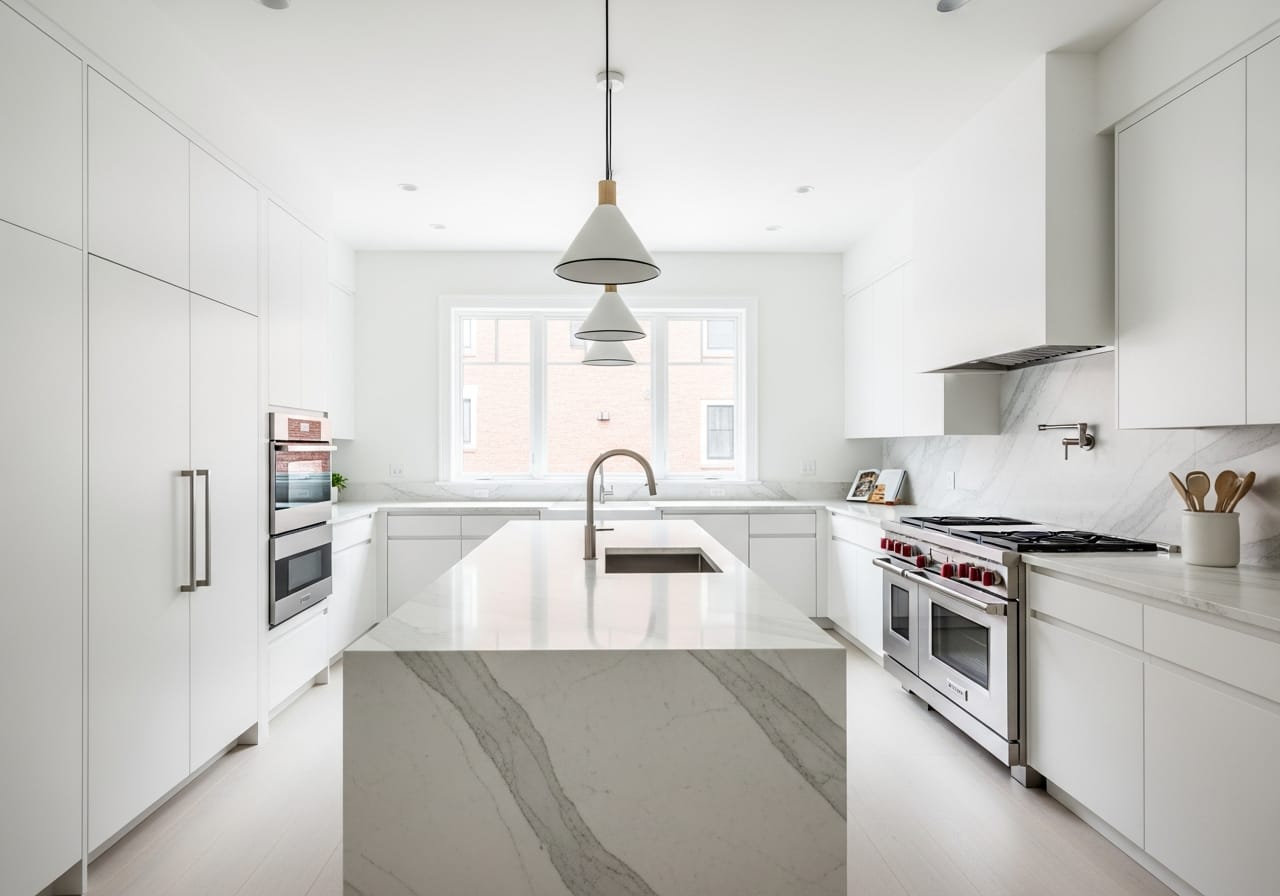
Part of our guide: Kitchen Renovation in Surrey: The Complete Planning Guide
Want a firm number for your project? Free on-site quote, itemized in writing.
+1 (778) 861-6482Countertops take more daily abuse than any other surface in a home: hot pans, dropped mugs, spilled wine, cutting boards that slide, and the constant wipe-downs of family life. Choosing between quartz and granite, or stepping down to laminate or over to butcher block, comes down to how you actually cook and clean, not just which slab looks better in the showroom. This guide compares the main options honestly, with an eye to how they perform in busy Lower Mainland kitchens.
What is the real difference between quartz and granite?
Granite is natural stone cut straight from the quarry, while quartz is an engineered surface made of roughly ninety percent ground natural quartz bound with resins and pigments. The practical consequence: granite is porous and needs periodic sealing, while quartz is non-porous and needs no sealing at all.
That single difference drives most of the decision. Because granite is a natural material, every slab is unique, with mineral veining and movement no factory can replicate. That is its charm and its catch: you should view and tag your actual slab, because the sample chip in the showroom only approximates it. Quartz, being manufactured, is consistent from sample to slab and from one end of the counter to the other, and modern lines convincingly mimic marble veining and honed stone. Both are heavy, both are fabricated and installed by professionals, and both instantly raise the perceived quality of a kitchen compared with the surfaces they usually replace.
Which countertop is more durable and easier to maintain?
Quartz is the lower-maintenance surface: it resists staining without any sealing and shrugs off daily wear with nothing more than soap and water. Granite is extremely hard and scratch-resistant but relies on its sealer, which should be refreshed periodically to keep oil, wine, and coffee from soaking in.
In day-to-day use, the difference shows up at the edges of routine. A forgotten puddle of red wine overnight on well-sealed granite is usually fine; on neglected granite, it can shadow. On quartz it wipes away regardless. Granite handles heat better: a hot pot set directly on it is unlikely to cause damage, while quartz resins can discolour or crack under the same treatment, so trivets are non-negotiable with quartz. For scratches, both surfaces will dull your knives before your knives visibly damage them, but cutting boards remain the rule on both, more to protect the blade and the finish than the slab itself. If a chip does happen, granite can often be colour-matched and repaired discreetly; quartz repairs are possible but can be more visible on plain, light patterns.
How do laminate and butcher block compare?
Laminate is the budget option and has improved dramatically, while butcher block brings warmth and a workable surface at a moderate price. Neither matches stone for longevity, but both have legitimate places in a renovation.
Modern laminate is not the laminate of the 1980s. High-definition printing and textured finishes produce convincing stone looks, and new profiles have slimmed down the once-obvious brown seam line at the edge. It resists stains well but is vulnerable to heat, deep scratches, and water infiltration at seams, especially around the sink. For rental suites, laundry rooms, and tight budgets, it is a rational choice. Butcher block, usually maple or oak in our market, is warm underhand, quiet, and kind to dishes, and light damage sands out. It demands regular oiling and quick attention to standing water, so many homeowners use it selectively, on an island as a working surface, with quartz or granite on the perimeter runs. That mixed approach is increasingly popular in Surrey kitchens and lets each material do what it does well.
Which countertop suits a busy family kitchen in the Lower Mainland?
For most busy households in Surrey and Greater Vancouver, quartz is the practical winner because it removes maintenance from the equation entirely. Granite remains the right choice for households that cook with high heat, love natural stone character, and do not mind resealing as part of home upkeep.
Think about who uses the kitchen. If teenagers make snacks unsupervised, if spills sit until someone notices, if nobody will remember a sealing schedule, quartz forgives all of that. Its consistency also helps in open-plan homes where the island is essentially furniture, since the slab matches the sample you approved. Granite rewards a more attentive household with a surface no two neighbours share, better heat tolerance for wok cooking and canning season, and a natural depth that engineered patterns still chase. Colour choice matters too: in our grey winters, Lower Mainland homeowners often lean toward lighter counters to keep kitchens bright, and both materials offer strong options there.
How does countertop choice fit into the overall kitchen budget?
Countertops are one of the top three cost drivers in a kitchen renovation, alongside cabinets and layout changes, within the typical Surrey range of $25,000 to $80,000 and up for a full project. Exact countertop pricing varies with the material line, slab thickness, edge profile, and how many cutouts and seams your layout needs, so it is confirmed through a free quote.
A few decisions move the countertop line item more than the material choice itself. Waterfall ends, where the counter flows down the side of an island, add fabrication and material. Complex edge profiles cost more than a clean eased edge. Undermount sinks require polished cutouts. And the timing matters: fabricators template only after cabinets are installed, then need one to two weeks to cut and finish, which is built into the schedule in our complete kitchen renovation planning guide for Surrey. When we manage a kitchen renovation, we coordinate the slab viewing, templating, and installation so the counters land exactly when the project needs them.
Frequently asked questions
Does quartz ever need sealing?
No. Quartz is non-porous, so there is nothing for a sealer to soak into. Routine cleaning with mild soap and water is all it requires, and abrasive pads and harsh solvents should be avoided to protect the finish.
How often does granite need to be resealed?
It depends on the stone and the sealer, but checking annually is a good habit. The simple test: sprinkle water on the surface, and if it stops beading and starts darkening the stone within a few minutes, it is time to reseal. Resealing is a quick DIY-friendly task.
Can I put hot pots directly on my countertop?
On granite, generally yes, though repeated extreme heat in one spot is still unwise. On quartz, no, always use a trivet, because the resin content can discolour or crack from thermal shock. On laminate and butcher block, never.
Still torn between slabs? The fastest way to decide is to see samples against your cabinet colours in your own light. Ali's Old To New General Contracting offers free consultations throughout Surrey and Greater Vancouver. Contact us or call 778-861-6482 and we will help you choose a surface that fits how your family actually lives.
More in This Guide
Services Related to This Guide
Planning a Renovation?
Get a free consultation and quote from a fully insured Surrey general contractor.
Get a Free Quote